Water purification cannot rely on a universal standard; it requires customized solutions targeted at different water quality challenges. According to your expected water quality standards — basic clear water, qualified drinking water or lab-level ultrapure water — we match three core water treatment technologies: Ultrafiltration (UF), Reverse Osmosis (RO) and Electrodeionization (EDI).
1. Ultrafiltration (UF): Fine Physical Filtration for Low-Salinity Raw Water
1.1 Working Principle of Hollow Fiber Membrane UF
The ultrafiltration system can be regarded as an ultra-precise physical sieve. It adopts hollow fiber membrane with 0.01–0.1 micron micropores to physically intercept sediment, rust, colloids and most bacteria in turbid, low-salinity water sources.
It only removes suspended impurities instead of dissolved salts, yet it features large water flow and low maintenance difficulty.
1.2 Applicable Scenarios for UF Equipment
UF serves as a complete independent purification solution for non-drinking water scenarios, including domestic bathing water, landscape irrigation and primary industrial water pretreatment.
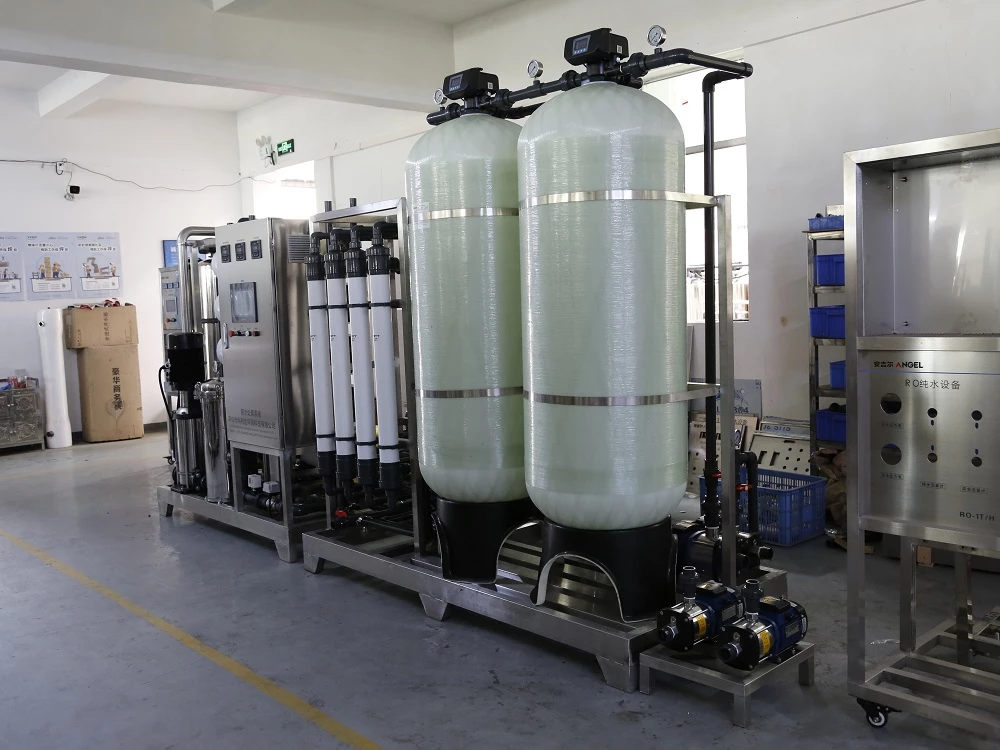
2. Reverse Osmosis (RO): Cost-Effective Desalination for Bottled Drinking Water
2.1 Molecular Diffusion Filtration Principle
Different from the simple physical interception of UF, RO relies on the molecular diffusion principle. The high-pressure pump provides 6–20 kg/cm² external pressure to push water molecules through thin-film composite polyamide membranes against the natural osmosis direction.
The membrane surface is covered with nano wrinkles to form special water channels, realizing dual interception of size screening and charge repulsion.
2.2 Excellent Rejection Performance of RO Membrane
- Divalent ions such as sulfate: rejection rate up to 99.7%
- Monovalent ions such as chloride: rejection rate over 95%
- Heavy metals, fluoride, pesticides and other dissolved pollutants can be effectively removed
RO is the most widely used and economical desalination technology worldwide, perfectly matching brackish water treatment and bottled drinking water production demands.
3. Electrodeionization (EDI: Polishing Technology for Industrial Ultrapure Water)
EDI is a high-end post-processing polishing technology for biopharmaceutical, semiconductor and other precision industries that require ultrapure water.
It combines electric field and ion exchange resin, continuously extracting residual ions from water without chemical agents. It can stably produce ultrapure water with resistivity of 15–18 MΩ·cm, supporting long-term continuous and environmentally friendly operation.
4. Optimized Anti-Fouling RO System from ShineDew Machinery
4.1 Core Industry Pain Point: Membrane Fouling & Scaling
Although RO has wide adaptability, membrane surface dirt and scaling have long troubled water plant operators, increasing cleaning costs and shortening membrane service life.
4.2 Our Professional Optimization Design
- Low surface roughness membrane material (Ra ≤40nm) with hydrophilic modified coating to reduce pollutant adhesion
- Built-in Intelligent Control System, dynamically adjusting water recovery rate between 50%–75% according to influent water quality
- Reduce membrane cleaning frequency by 40%, improve overall operation efficiency and extend membrane service life
5. Customized Purification Logic Matching Service from ShineDew Machinery
UF, RO and EDI respectively represent the top technologies of physical filtration, molecular separation and electrochemical purification.
ShineDew Machinery does not simply sell single water treatment machines. We analyze your raw water condition and end-use requirements, and configure the most economical and stable combined purification scheme for you. There is no universal perfect water treatment system, only the purification logic tailored to your actual production demands.