PET and HDPE are two of the most widely applied thermoplastic polymers for beverage packaging, food containers and industrial plastic products. They differ greatly in chemical composition, performance, recycling standards and application scenarios. Below is a detailed professional introduction to PET and HDPE.
1. Polyethylene Terephthalate (PET / PETE)
1.1 Basic Definition & Global Brand Aliases
Polyethylene terephthalate, also written as poly(ethylene terephthalate), is usually shortened to PET or PETE; outdated abbreviations include PETP and PET-P. As the mainstream thermoplastic polyester resin, it is widely applied in clothing fiber, liquid & food packaging bottles, industrial thermoforming, and glass fiber reinforced engineering plastic.
This material has different well-known brand names in different regions: Terylene (UK), Lavsan (Russia & former Soviet Union), Dacron (USA).
1.2 Global Production & Main Application Fields
Over 60% of global PET output is used for synthetic textile fibers, while bottle manufacturing takes up roughly 30% of total market demand. In textile industries, PET is simply called polyester; the abbreviation PET is mostly used for packaging scenarios.
Polyester accounts for around 18% of global polymer output, ranking 4th after PE (polyethylene), PP (polypropylene) and PVC (polyvinyl chloride).
1.3 Molecular Structure & Recycling Mark
PET is formed by polymerizing ethylene terephthalate monomers, with repeated C₁₀H₈O₄ molecular units. It is fully recyclable, marked with resin identification code (RIC) number 1.
1.4 Annual Output & Recycled PET Applications
Global annual PET production reached an estimated 56 million tons in 2016. Compared with other plastics, PET bottles are much easier to recycle, thanks to high resin value and universal use in mineral water and carbonated drink packaging.
Major downstream products of recycled PET: polyester textile fiber, plastic strapping bands, non-food plastic containers.
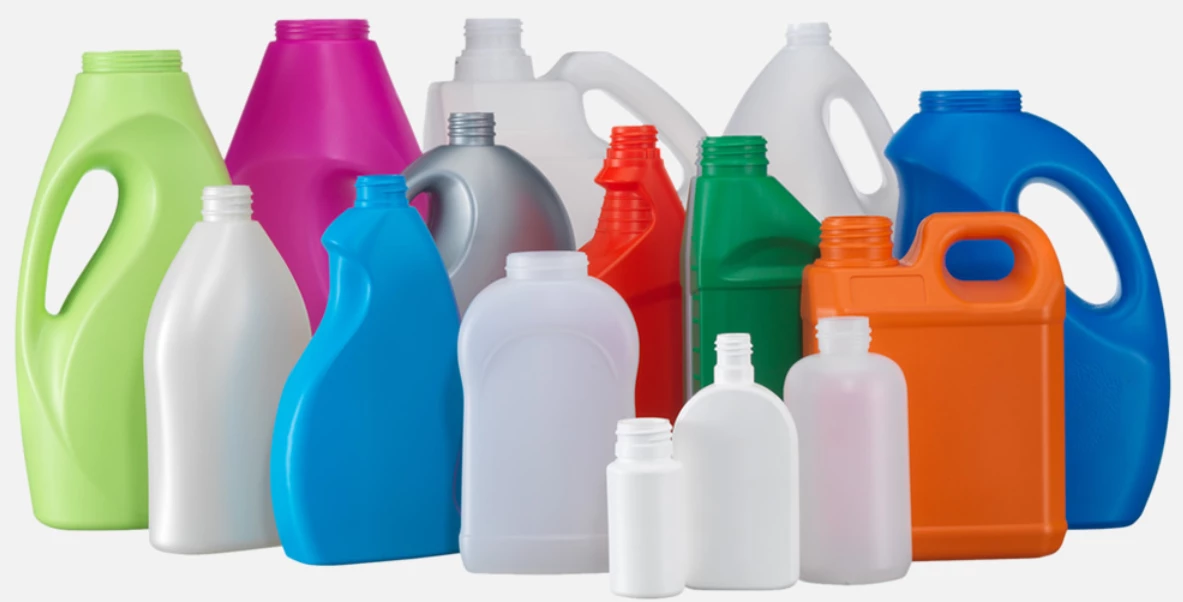
2. High-Density Polyethylene (HDPE / PEHD)
2.1 Material Overview & Core Features
High-density polyethylene (HDPE, also named PEHD) is a thermoplastic polymer made from ethylene monomers. HDPE pipe products are sometimes referred to as alkathene or polythene. Featuring an outstanding strength-to-density ratio, HDPE is manufactured into plastic bottles, anti-corrosion pipelines, geomembranes and plastic lumber.
HDPE can be recycled, with resin identification code number 2.
2.2 Common Packaging Usage Scenarios
- Containers for household cleaning supplies
- Bulk food packaging such as ketchup bottles
- Personal care product bottles: shampoo, conditioner and more
3. Core Difference Between PET and HDPE for Beverage Packaging
PET (Code 1) is the primary material for disposable mineral water and carbonated drink bottles, lightweight, transparent and suitable for high-speed filling production lines. HDPE (Code 2) is opaque, with better chemical resistance, mostly adopted for detergent, condiment and daily chemical containers instead of carbonated beverage packaging.